-
 Industries OverviewThe company's products are primarily used in industrial equipment sectors such as nuclear power, petroleum, petrochemicals, chemical engineering, power generation, automotive manufacturing, shipbuilding, fertilizer production, pharmaceuticals, papermaking, sugar refining, and machinery manufacturing.
 -
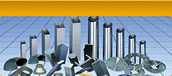 Products & SolutionsOur Products: Ferrous metal ore raw materials (nickel ore, ferronickel, ferrochrome, ferromanganese, ferrosilicon, etc.), seamless pipes, welded pipes, medium-thick plates, plate coils, bars, wire rods, wire coils, pipe fittings, flanges, castings, etc.
 -
 CommunityThe company has established an excellent reputation within the industry through its strong credibility, comprehensive services, and ample resources.
 -
 Process VisualizationThe company's products are primarily used in industrial equipment sectors such as nuclear power, petroleum, petrochemicals, chemical engineering, power generation, automotive, shipbuilding, fertilizer production, pharmaceuticals, papermaking, sugar refining, and machinery manufacturing.
 -
 About UsTsisco Industrial Ltd. was established in 2010. Originating from the Tsingshan ecosystem’s Shanghai platform, the company now operates independently and focuses on global supply-chain integration, distribution, and import/export of steel and alloy materials. We achieved ISO 9001 certification from TÜV Rheinland in 2012, and ISO 9001, ISO 14001 and ISO 45001 certifications from LRQA in 2022. These accreditations underpin continuous improvement and stable performance in quality, environment, and occupational health & safety.
-
Products & Solutions
Super Austenitic Stainless Steel Pipes
Super Austenitic Stainless Steel Pipes

Super Austenitic Stainless Steel Pipes|Global Sourcing for Engineering & Procurement
1. Product Positioning & Application Scope
Positioning: Super austenitic stainless steel pipes are high-alloy Cr-Ni-Mo austenitic materials with nitrogen strengthening and high pitting resistance (PREN), typically including 904L (N08904), 254SMo (S31254), AL-6XN (N08367), Alloy 926 (N08926), and 654SMO (S32654). They offer excellent resistance to pitting, crevice corrosion, and chloride stress-corrosion cracking, suitable for media with elevated chlorides, oxidizing conditions, and certain acidic environments.
Applications: Seawater desalination (intake, pre-treatment, high-pressure side), seawater/brine cooling and water injection, chemical and fine chemical services (sulfuric acid, phosphoric acid, mixed acids with chlorides), flue-gas desulfurization, pulp-and-paper bleaching lines, process water and ultrapure water for food and pharma, offshore platforms, heat-exchanger and condenser tubing.
Boundaries & Complements: Consider nickel alloys (e.g., 625, C-276) for harsher chloride and temperature with strong reducing media; consider duplex grades (e.g., 2205, 2507) where strength and cost take priority at slightly lower corrosion demand.
2. Standards Matrix (Global & Regional, incl. Dimensions and General Requirements)
Products & General:
• ASTM A312 (seamless and welded austenitic stainless steel pipe; covers 904L, S31254, N08367, N08926, S32654, etc.).
• ASTM A213 (seamless stainless steel tubes for boilers and heat exchangers).
• ASTM A269 (seamless and welded austenitic stainless steel tubing for general service).
• ASTM A358 (electric-fusion-welded austenitic stainless steel pipe).
• ASTM A376 (seamless austenitic stainless steel pipe for high-temperature service, project-dependent).
• ASTM A1016 / ASTM A999 (general requirements for tubes/pipes).
• ASME B36.19M (stainless steel pipe dimensions and schedules).
• EN 10216-5 (seamless stainless steel tubes for pressure purposes), EN 10217-7 (welded stainless steel tubes for pressure purposes).
• ISO 1127 (stainless steel tubes — dimensions and tolerances; D/T classes by agreement).
• ASME BPE, ISO 2037 (bioprocessing/sanitary piping, used when applicable).
• NACE MR0175 (ISO 15156) / NACE MR0103 (sour-service applicability, project-specific).
• NORSOK M-630 (MDS for offshore materials, including 6Mo grades).
• PED 2014/68/EU (EU pressure equipment directive compliance where required).
3. Scenario–Material–Standard–Size Mapping (Ready-to-Buy Text Guide)
• SWRO high-pressure side (RO shell side and piping): 254SMo (S31254) or AL-6XN (N08367). Use A213 for exchanger tubes and A312 / A358 for pressure/utility piping. Typical OD 19.05–25.4 mm for tubes (1.24–2.11 mm WT) or metric OD 25–168 mm for piping to ASME B36.19M schedules.
• Seawater/brine cooling & offshore water injection: S31254, N08926. Use A312 / A358; A213 for tubing. Sizes per design pressure and line class, commonly OD 25–323.9 mm.
• FGD absorbers and chemical towers/HEX: N08926, N08904 (904L). Use A312 / A358 (towers/lines) and A213 (bundles). Large-bore piping via A358; tube ODs 19.05–25.4 mm common.
• Sulfuric/phosphoric/oxidizing mix acids with chlorides: N08926, N08367. Use A312 / A213. Choose higher-PREN materials for elevated temperature/concentration.
• Pulp-and-paper bleaching and chloride process waters: S31254. Use A213 (tubes) or A312 (piping). Common OD 19–114.3 mm.
• Food, pharma, electronics, and UPW: S31254 or 904L (with chloride limits and sanitary requirements). Use A269 / ASME BPE / ISO 2037 as applicable; BA/EP finish; common OD 12.7–101.6 mm.
• Boundary note: For very high chlorides at elevated temperatures with crevice/stagnation risks or strong reducing acids, evaluate upgrading to nickel alloys.
4. Size Range & Tolerances
• OD: Seamless and welded straight pipes approx. 6–610 mm; common project piping 12–323.9 mm.
• Wall: Approx. 0.8–50 mm to ASME B36.19M schedules or per calculation.
• Length: 6 m and 12 m standard; heat-exchanger tubes 6–24 m, U-bend available.
• Ends: Plain or beveled per ASME B16.25; sanitary ferrules with EP possible.
• Tolerance system: Default to ASTM A999 / A1016 and ASME B36.19M; alternatively adopt ISO 1127 D3/D4 (diameter) and T3/T4/T5 (thickness) by agreement; ASME BPE / ISO 2037 for sanitary service.
• Geometry: Straightness and ovality to be quantified by project; heat-exchanger tubes may follow TEMA and fabrication rules for tighter fit-up.
5. Manufacturing Process & Key Controls
• Melting: EAF with AOD/VOD, ESR where needed; low-C, uniform alloying, high cleanliness; meet PREN targets.
• Forming: Seamless via piercing-extrusion or piercing plus cold pilger/drawing; welded via GTAW/PAW and full-length solution anneal; large-bore EFW per A358. Grind/flush weld beads and pickle/passivate.
• Heat treatment: Solution anneal typically 1,150–1,200 °C with rapid quench to avoid σ/χ phase; ensure quench rate for thick sections.
• Welding practice: Use over-matching Ni-alloy fillers (e.g., ERNiCrMo-3 or equivalent), control interpass temperature and purge quality, and pickle/passivate after welding.
6. Quality Control & Documentation
• Chemistry & PMI: Heat analysis with PMI on critical lots.
• Mechanical & hardness: As per product standard; sample welds/HAZ where applicable.
• Corrosion testing: ASTM A262 Practice E (IGC) and ASTM G48 Method A/C (pitting/crevice). Project-specific PREN floors or CPT references may apply.
• NDE & pressure tests: UT/ET/RT coverage to code/project; hydro or pneumatic tests per standard.
• Surface & cleanliness: Pickled + passivated, BA or EP where specified; sanitary systems require Ra and cleanliness records.
• Docs: EN 10204 3.1 or 3.2; heat-treat charts, NDE reports, corrosion test reports, full traceability, and third-party inspection where required; NACE and PED statements as applicable.
7. Supply Forms & Packaging
• Forms: Seamless/welded straight pipes, U-bend exchanger tubes, process spools.
• Surface: Pickled/passivated, BA, or EP.
• Packing: Plastic end caps, dry and chloride-free packing, reinforced wooden crates; double-bag clean packing and cleanliness reports for sanitary/UPW.
8. RFQ Essentials (Copy-Ready)
1. Standard & edition: ASTM A312 / A213 / A269 / A358 with year; specify ASME B36.19M and ISO 1127 tolerance class (e.g., D3/T3).
2. Grade & condition: e.g., “S31254 solution-annealed and pickled,” “N08367 solution-annealed, bright-annealed.”
3. Size & ends: OD × WT × length; PBE/BE; for sanitary service state Ra and EP/BA.
4. Tests & inspection: UT/ET/RT coverage; hydro or pneumatic; A262 E, G48 A/C; PMI; EN 10204 3.1 or 3.2.
5. Welding requirements: Filler class, purge quality, pickle/passivation; FN limits for welds if required.
6. Compliance & TPI: NACE / PED / NORSOK; TPI agency and inspection points.
9. Material Selection Guide
• Elevated chlorides, mid-to-high temperature, crevice risks: Choose 6Mo-class (S31254, N08367, N08926) with PREN ≥ 42.
• Extreme chlorides with strong reducing acids: Consider upgrade to Ni-alloys (e.g., 625, C-276).
• Sanitary/UPW with controlled chlorides: 904L or 6Mo with BA/EP.
• Large-bore high-pressure lines: Prefer A358 with proper filler selection and full-length solution anneal.
10. Procurement, Construction & O&M Risk Notes
• Prevent carbon-steel contamination; mandatory pickle and passivation after welding.
• Avoid chloride-laden insulation and cleaners; minimize crevices and stagnation.
• Control heat input/interpass; ensure high-purity backing gas.
• Provide cathodic protection and insulating joints in seawater systems.
• Assess Cl-SCC risk versus temperature and set operating limits accordingly.
11. Representative Spec Lines (Copy-Ready)
• “Pipe, ASTM A312, S31254, DN 100 (4 in), Sch 40S, L = 6 m, BE; solution-annealed and pickled; 100% UT, hydro; ASTM A262 E and ASTM G48-A at 25 °C passed; EN 10204 3.1.”
• “U-bend heat-exchanger tubes, ASTM A213, N08367, OD 25.4 mm × WT 1.65 mm, U-radius per drawing, BA; 100% ET, hydro; EN 10204 3.1.”
• “EFW pipe, ASTM A358 CL.1, N08926, NPS 16, Sch 40S, solution-annealed and pickled; filler ERNiCrMo-3; 100% RT + 100% UT; NACE MR0175 statement; EN 10204 3.2.”
12. Representative Global Manufacturers (Examples, A–Z)
• Alleima (formerly Sandvik Materials Technology; S31254, N08367 tubes and HEX tubes).
• BUTTING (Germany; welded stainless and high-alloy piping incl. A358).
• Mannesmann Stainless Tubes (Europe; high-alloy seamless and welded tubes).
• Nippon Steel Stainless / Nippon Yakin Kogyo (Japan; stainless and high-alloy materials/tubing).
• Outokumpu (Europe; stainless and high-alloy materials and welded pipe systems).
• Tubacex Group (global; stainless and high-alloy tubes incl. heat-exchanger and process piping).
Note: Capability envelopes, heat-treatment windows, and certifications vary by manufacturer. Final supply shall follow mill datasheets and the purchase contract.
Super Austenitic Stainless Steel Pipes|Technical Specifications
1) Product definition & applications
• Definition: High-Ni/Mo/N austenitic stainless tube/pipe families such as UNS S31254 (254SMO), N08367 (AL-6XN), N08926 (1.4529/Alloy 926), S32654 (654SMO) in seamless and welded forms for services beyond 304/316 capability.
• Applications: Seawater/brine heat-exchange and transport, desalination (hot/cold ends), chlor-alkali/phosphate/fertilizer units, pulp bleaching (ClO₂), FGD, chlorinated organics/mixed acids, offshore platform firewater/cooling, high-pressure heat exchangers and tube-to-tubesheet transitions.
2) Standards matrix
• ASME/ASTM (primary product specs)
• ASTM A312/A312M (seamless & welded austenitic pipes; covers S31254/S32654 etc.).
• ASTM A269 (general small-diameter austenitic tubes).
• ASTM B67x family (B673/B674/B675/B676/B677, etc.) mapped by UNS for high-Ni/super-austenitic tube/pipe forms.
• General requirements: ASTM A1016/A999 per the selected product spec.
• EN/ISO/JIS/GB
• EN 10216-5 (seamless), EN 10217-7 (welded), ISO 1127 (D/T tolerance classes).
• JIS G3463, GB/T 14976 / GB/T 13296 as applicable.
• Offshore/Oil & Gas
• NORSOK M-630 (MDS) and NORSOK M-601 (welding & inspection).
• ISO 15156/NACE MR0175/MR0103 for sour/refining environments.
3) Grades (indicative PREN ranking)
• 6Mo: UNS S31254 (254SMO/1.4547), N08367 (AL-6XN), N08926 (1.4529/Alloy 926) — mainstay for seawater/brine, bleaching, FGD.
• 7Mo: UNS S32654 (654SMO) — top-tier for extreme pitting/crevice at higher temperature/Cl⁻.
• High-Ni austenitic (PREN < 6Mo): UNS N08904 (904L) — good for uniform acids; not a 6Mo replacement in hot-chloride/crevice regimes.
• Note: PREN varies with melt chemistry; a project PREN floor is recommended in the PO.
4) Sizes & tolerances (typical engineering window)
• Process pipe: OD 6–610 mm, WT 0.8–40 mm, length 6/12 m typical.
• Heat-exchanger tubes: OD 19 or 25.4 mm, BWG 14–12 (≈ 1.65–2.11 mm), length 3–9 m; U-bends per TEMA/SA556.
• Tolerances: ASTM A1016/A999 or ISO 1127 (D/T classes); explicitly state max ovality, eccentricity, straightness & squareness.
5) Manufacturing & process control
• Seamless (premium/heavy-wall): AOD/VOD → hot extrusion to hollow → cold pilger/draw → solution anneal (>1150 °C) with rapid quench → pickling/BA/EP → NDE/hydro.
• Welded (cost-effective for thin/medium walls & long random lengths): strip/plate forming → GTAW/laser/PAW with full purge → post-weld solution + pickling → sizing → 100% weld NDE + full-length ET → hydro.
• Welding & assembly: High-Ni fillers (ERNiCrMo-3/-4), strict back-purge/low O₂, controlled heat input/interpass; post-weld pickling & passivation (ASTM A380/A967).
6) Performance & qualification
• Chemistry/cleanliness with Ni/Mo/N meeting grade and project PREN floor.
• Mechanical: tensile; impact if required.
• Corrosion: ASTM G48 (Method A/E or CPT/CCT), ASTM A262 if needed.
• NDE/hydro: ET/UT/RT/DR per spec; 100% hydro or approved tightness alternative.
• Welding QPs: WPS/PQR to ASME IX/ISO 15614; NORSOK M-601 for offshore/O&G.
7) Service → material quick selection
• Seawater/brine ≤ 60 °C, controlled crevices: S31254 / N08367.
• Seawater/brine > 60 °C or unavoidable crevices/deposits: N08926, escalate to S32654 for extremes; consider Ni-alloys (625/C-276) as the upper bound.
• FGD/fertilizer/phosphate acids: N08904 as economic option; move to 6Mo/7Mo with increased Cl⁻/F⁻, temperature or crevice risk.
• Pulp bleaching (ClO₂): 6Mo family with CPT/CCT verification.
• Offshore firewater/cooling: 6Mo/7Mo for high turbulence, ensure weld/crevice control.
• Sour service: verify ISO 15156/NACE MR0175 applicability; upgrade to Ni-alloy if required.
8) Construction risks & controls
• Proper filler choice, back-purge and heat tint removal; post-weld pickling/passivation.
• Avoid chloride-bearing cleaners; flush/dry before service; minimize stagnation/crevices.
• Consider galvanic isolation vs. CS/Cu/Ti; CP as required.
• Manage stress/thermal cycles to avoid SCC envelope exceedance.
9) Supply, packaging & documentation
• Forms: seamless/welded straight tubes & pipes, HEX tubes, U-bends.
• Finishes: pickled/BA/EP; clean/oil-free with particulate/TOC limits for clean/UHP duties; double-bagging.
• Docs: EN 10204 3.1/3.2, NDE/hydro, heat-treat charts, G48/CPT/CCT, welding QPs and TPI if applicable.
10) RFQ / PO checklist (ready-to-use)
1. Grade + spec + form (e.g., UNS S31254 / ASTM A312 / Seamless; UNS N08926 / ASTM B677 / Seamless; UNS N08367 / ASTM B675/B676 / Welded Tube).
2. Size & tolerance (OD×WT×L; A1016/A999 or ISO 1127; max ovality/eccentricity/straightness).
3. Route (seamless hot-extruded mother + cold finishing, or welded with 100% weld NDE) & HT state.
4. Qualification (ET/UT/(RT/DR), hydro; G48 Method & acceptance/CPT/CCT; A262 if required).
5. Welding (filler, purge O₂ limit, post-weld surface treatment) & end prep (ASME B16.25).
6. Project specs (NORSOK M-630/M-601; ISO 15156/NACE).
7. Docs & TPI (3.1/3.2, HT charts, NDE/hydro/corrosion test reports).
8. Packing/cleanliness (caps, VCI/dry, cleanliness/TOC & traceability).
11) Typical mistakes & risk list
• Treating 904L as equivalent to 6Mo/7Mo in hot-chloride/crevice-prone duties.
• No G48/CPT/CCT acceptance in the technical annex.
• Wrong fillers (316L/308L), poor purge, heat tint left in place.
• Inadequate solution/rapid quench → σ/χ formation; HAZ sensitization.
• Ignoring crevice/stagnation & galvanic couples; no isolation/CP.
• Cross-system fit-up errors (ASME vs EN/JIS/GB dimensions/gaskets/bolt patterns).
12) Global ecosystem & representative companies (illustrative; verify in RFQ)
• Melting/flat/long (high-alloy stainless): Aperam (Uranus B66); ATI (AL-6XN®); Nippon Yakin Kogyo (NAS high-alloy); Outokumpu (254SMO®/654SMO®); VDM Metals (Cronifer 1.4529/N08926, N08904).
• Tube manufacturers (seamless/welded): Alleima; BUTTING; Centravis; NEOTISS; Nippon Steel Stainless Pipe & Tube; Salzgitter Mannesmann Stainless Tubes; Tubacex Group; RathGibson / PCC Energy Group; Fine Tubes / Superior Tube; Jiuli Hi-Tech (China).
• Note: coverage of UNS/forms (seamless/welded/HEX) varies; validate scope, certifications and recent references.
13) Example spec lines (copy-paste ready)
• Case A — Seawater HEX U-tube (warm end)
Grade/spec: UNS S31254 / ASTM A312 (Tube); form: U-tube (TEMA RCB-2.31)
Size: OD 25.4 mm × WT 2.11 mm × leg 7.5 m; radius & developed length per drawing
Route: seamless (extruded mother + cold pilger) + solution + pickled/BA
Tests: ET 100% + hydro each; ASTM G48 Method A (temp/time) pass; MTC 3.1 + U-bend geometry report
• Case B — Offshore firewater header (high turbulence)
Grade/spec: UNS N08926 (1.4529) / ASTM B677 (Seamless)
Size: OD 114.3 mm × WT 8.56 mm × L 6 m; ends B16.25 bevel
Welding: ERNiCrMo-3 filler, full purge, post-weld pickling/passivation
Tests: UT/ET 100%, hydro; per NORSOK M-601; docs 3.1/(3.2 if TPI)
• Case C — FGD recycle loop (economic option)
Grade/spec: UNS N08904 / ASTM A312 (Welded)
Size: OD 168.3 mm × WT 5.0 mm × L 12 m
Route: GTAW + solution + pickled; weld ET 100%
Corrosion: G48 (CPT target) and A262 as needed; MTC 3.1
• Case D — Extreme brine hot section (upper bound)
Grade/spec: UNS S32654 / ASTM A312 (Seamless)
Size: OD 60.3 mm × WT 6.35 mm × L 6 m
Tests: UT/ET 100%, hydro; G48 Method E (crevice); benchmark vs Alloy 625 or C-276 if required
Tags: