-
 Industries OverviewThe company's products are primarily used in industrial equipment sectors such as nuclear power, petroleum, petrochemicals, chemical engineering, power generation, automotive manufacturing, shipbuilding, fertilizer production, pharmaceuticals, papermaking, sugar refining, and machinery manufacturing.
 -
 Products & SolutionsOur Products: Ferrous metal ore raw materials (nickel ore, ferronickel, ferrochrome, ferromanganese, ferrosilicon, etc.), seamless pipes, welded pipes, medium-thick plates, plate coils, bars, wire rods, wire coils, pipe fittings, flanges, castings, etc.
 -
 CommunityThe company has established an excellent reputation within the industry through its strong credibility, comprehensive services, and ample resources.
 -
 Process VisualizationThe company's products are primarily used in industrial equipment sectors such as nuclear power, petroleum, petrochemicals, chemical engineering, power generation, automotive, shipbuilding, fertilizer production, pharmaceuticals, papermaking, sugar refining, and machinery manufacturing.
 -
 About UsTsisco Industrial Ltd. was established in 2010. Originating from the Tsingshan ecosystem’s Shanghai platform, the company now operates independently and focuses on global supply-chain integration, distribution, and import/export of steel and alloy materials. We achieved ISO 9001 certification from TÜV Rheinland in 2012, and ISO 9001, ISO 14001 and ISO 45001 certifications from LRQA in 2022. These accreditations underpin continuous improvement and stable performance in quality, environment, and occupational health & safety.
-
Products & Solutions
Metal Hot Extruded Tubes
Metal Hot Extruded Tubes

Metal Hot Extruded Tubes|Global Sourcing for Engineering & Procurement
1. Product Positioning & Application Scope
1) Positioning
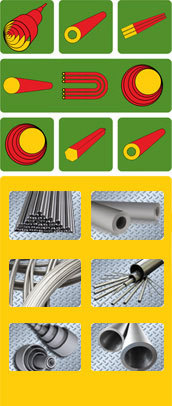
Metal hot-extruded tubes are seamless hollow products formed primarily by hot extrusion. They suit small–medium OD, thick wall, high-alloy and high-cleanliness requirements. They can be supplied as finished tubes or as mother tubes for subsequent cold processing (cold rolling, drawing, pilgering).
2) Typical Applications
Chemicals and fine chemicals, oil & gas and offshore, power generation (coal/gas/nuclear/geothermal), pharma and electronics (high-purity media), general equipment, heat exchange and process control.
3) Process Boundaries
For large OD or extra-long straight pipes, mandrel rolling/plug mill/expander or plate-welded routes (UOE, longitudinal weld, EFW) are usually more economical. Tubes for furnace radiant sections above about 900 °C typically adopt centrifugally cast heat-resistant alloys (ASTM A608/A297), which are outside hot-extrusion’s core domain.
2. Standards Matrix (Buyer’s View)
Note: Extrusion is a manufacturing route; supplied products shall meet the corresponding “product standard + general requirements + dimensional series.” Always state the edition year in the PO.
1) General Requirements & Dimensional Series
• Steel and stainless tube general requirements: ASTM A1016.
• Steel and stainless pipe general requirements: ASTM A999 (alloy & stainless pipe), ASTM A530 (general requirements for carbon and alloy steel pipe, e.g., ASTM A106).
• Carbon/low-alloy tube general requirements: ASTM A450 (e.g., ASTM A179, A210, A209).
• Nickel and Ni-alloy tube/pipe general requirements: ASTM B829.
• Dimensional series: ISO 1127 (metric stainless), ASME B36.10 (CS/AS pipe NPS series), ASME B36.19 (SS pipe NPS series).
2) Stainless & Duplex
• Austenitic SS: ASTM A312 (process/engineering pipe, seamless and welded), ASTM A213 (boiler & heat-exchanger tubes), ASTM A269 (general-purpose SS tubes).
• Duplex/super duplex: ASTM A789 (seamless & welded, tubing grade).
• Chemistry mapping: ISO 15510.
• EU pressure service reference: EN 10216-5 (SS seamless tubes for pressure purposes).
3) Alloy & Heat-Resistant Steels
• High-temperature ferritic alloy pipe: ASTM A335 (P-grades).
• Mechanical (non-pressure): ASTM A519 (mechanical tubing), EN 10297-1 (general-engineering seamless circular tubes).
4) Nickel & Ni-Base Alloys
• Alloys 600/601: ASTM B167; 625: ASTM B444; 800H/800HT: ASTM B407; 825: ASTM B423; Ni-Cr-Mo (e.g., C-276/C-22): ASTM B622. All paired with ASTM B829.
5) Titanium & Zirconium
• Ti & Ti alloys: ASTM B338 (tubes), ASTM B861 (pipe).
• Zr & Zr alloys: ASTM B523 (tubes), ASTM B658 (pipe).
6) Cu-Ni & Other Nonferrous
• Cu-Ni: ASTM B466 (seamless, tubing grade), ASTM B111 (seamless condenser & HX tubes).
3. Scenario–Material–Standard–Size Mapping (Quick Selection)
1) High-temperature steam/SH/RH (pressure service)
• Material: A335 P-grades (e.g., P22, P91) or A213 T-grades.
• Standards & general: A335 (+A999) / A213 (+A1016).
• Sizes: ASME B36.10 (NPS & wall series).
• Note: State heat treatment (N+T or Q+T) and impact/creep targets.
2) General corrosion-resistant process lines (low–moderate chlorides)
• Material: A312 TP316L/TP304L; where needed 317L, 904L, or 6Mo.
• Standards & general: A312 (+A999); for high cleanliness branches use A269 (+A1016).
• Sizes: ASME B36.19 or ISO 1127; add cold finishing where tighter tolerances are required.
3) Seawater/brine/high-chloride
• Material: A789 S32205 (2205), S32750/S32760 (super duplex).
• Standards & general: A789 (+A1016); verify with A923 (phase balance/detrimental phases) and G48 (pitting) as needed.
• Sizes: ISO 1127; align flange/bore with project standard.
4) Strong corrosion or high-temperature carburization resistance
• Material: B444 (Alloy 625), B423 (Alloy 825), B167 (Alloy 600/601), B622 (C-276/C-22).
• Standards & general: alloy-specific + B829.
• Sizes: ISO 1127 or per drawing.
5) High-purity/hygienic/electronic gases
• Material: 316L/304L.
• Standards & general: A269 or A213 (+A1016), specify BA/EP internal finish and clean packaging.
• Sizes: ISO 1127 (define internal roughness).
6) Titanium/zirconium heat exchangers & corrosion service
• Materials & standards: Ti B338 (tubes), Zr B523 (tubes)/B658 (pipe).
• Sizes: per drawing or ISO 1127-equivalent grade (by agreement).
4. Size Range & Tolerances (Typical Window)
• Outside diameter: ~19–260 mm (some mills ≈320 mm).
• Wall thickness: ~3–60 mm (SS/Ni alloys often 4–40 mm).
• Length: 6–12 m, fixed lengths available.
• Tolerance system: Prefer ISO 1127 D2/D3/D4 (OD) + T2/T3/T4 (WT) for stainless; use ASME B36.10/36.19 when adopting NPS series. Specify limits for eccentricity, ovality and straightness (e.g., eccentricity ≤10% as a common target).
5. Manufacturing Flow & Key Controls
• Melting & refining: EAF/BOF → AOD/VOD (for SS/high alloys) → ESR as required.
• Hot extrusion: set heat, extrusion ratio, lubrication and tooling per alloy; control WT uniformity, concentricity and surface integrity.
• Cold finishing (as required): cold rolling, drawing or pilgering to tighten tolerances and improve surface/mechanical properties.
• Heat treatment: SS solution anneal + rapid quench; alloy steel N/T or Q/T; Ni-alloy per product standard.
• Ends & surface: bevel per ASME B16.25; pickling & passivation or BA/EP finish (per cleanliness needs).
6. Quality Inspection & Documentation
• General & docs: A1016 or B829 (tube); A999 or A530 (pipe); EN 10204 3.1/3.2 CMTR.
• Chemistry & mechanicals: per product standards and delivery condition.
• Corrosion & phase: ASTM A262 for austenitic (if required); ASTM A923 and ASTM G48 for duplex.
• NDE & pressure: UT/ET/RT/MT/PT coverage per product standards and A1016/B829; hydro/pneumatic test per standard or drawing.
• Dimensions & surface: per ISO 1127 or ASME series; specify HR/HRAP/pickled or BA/EP.
7. Supply Forms & Packaging
• Supply forms: hot-finished (HFS) or cold-finished (CFS); straight tubes or coils (where applicable).
• Packaging: end caps + VCI/dry film or rust preventive; internal liners and external protection; clear ID (heat/lot, grade, size, tolerance class, length, weight). For clean service, double bag with inner seals.
8. Ordering Checklist (Copy-Ready)
1. Standard and edition (e.g., ASTM A312-2024, ASTM A789-2022, ASTM B444-2023, EN 10216-5).
2. Route (mandatory hot extrusion? any cold finishing) and heat-treat condition.
3. OD × WT × length and tolerance system (ISO 1127 D/T class or ASME B36.10/36.19), limits for eccentricity/ovality/straightness.
4. Tests: chemistry, mechanicals, NDE (coverage), pressure, corrosion/phase (A262/A923/G48).
5. Ends & finish: B16.25 bevel, pickled/passivated or BA/EP, cleanliness and oil-free declaration.
6. Regulations & special: NACE MR0175/ISO 15156 applicability and hardness windows for H₂S service (if applicable).
9. Quick Selection Guide (One-Liners)
A335/A213 for steam pressure; A312 316L for general corrosion; A789 2205/2507 for seawater; B444/B423/B167/B622 for strong corrosion or carburization; B338 (Ti) or B523/B658 (Zr) for heat exchangers.
10. Procurement/Construction/O&M Risk Alerts
• Do not assign >900 °C radiant-section duties to hot-extruded tubes (use ASTM A608/A297 centrifugally cast alloys).
• Do not mix ISO 1127 and ASME dimensional series without contractual alignment; avoid flange/bore mismatch.
• Skipping A923/G48 for duplex or A262 for austenitic leads to phase issues, early pitting or intergranular corrosion.
• Mixing pipe vs tube general requirements (A999/A530 vs A1016) causes acceptance disputes.
11. Representative RFQ/PO Lines
1. “Duplex stainless tube, ASTM A789 S32205, hot-extruded + cold-rolled, OD 168.3 mm × WT 10.97 mm × L 6 m; ISO 1127 D3/T3; A923/G48; A1016; EN 10204 3.1.”
2. “Ni-base alloy tube, ASTM B444 N06625, OD 73.0 mm × WT 8.0 mm × L 6 m; ASTM B829; UT/ET 100% + hydro; EN 10204 3.1.”
3. “Alloy steel pipe, ASTM A335 P22, OD 114.3 mm × WT 14.2 mm × L 6 m; ASME B36.10; A999; N+T; EN 10204 3.1.”
12. Representative Global Producers (Examples, Alphabetical)
Alleima (ex-Sandvik Materials Technology), Centravis, Jiuli Hi-Tech, Mannesmann Stainless Tubes, Nippon Steel Stainless, Tenaris, Tubacex Group, Vallourec, VSMPO-AVISMA (Ti), Wieland/KME (Cu-Ni).
(Manufacturing windows and metallurgy routes per mill datasheets and contract.)
Metal Hot Extruded Tubes|Technical Specifications
0) Critical Errata & Boundary Clarifications
1. Realistic size capability (steel): the typical engineering window for hot-extruded seamless tubes is OD 19–260 mm (rarely up to ≈320 mm), WT 3–60 mm, and length 6–12 m per bar. Requests well beyond this window (OD>260–320 mm or L>12–18 m) should be steered to mandrel/plug/push-bench rolling or plate-welded routes (EFW/LSAW/UOE/SAW).
2. Furnace radiant tubes (>900 °C): industry practice is centrifugally cast tubes (ASTM A608/A297, HK/HP-Mod), not hot-extruded tubes.
3. Nuclear primary piping (large bore): generally austenitic SA-312/SA-376/SA-358 solutions (with some cast components), not a hot-extrusion application; SG tubing is Alloy 690TT.
4. API 5L vs this category: API 5L/B31.4/B31.8 are pipeline standards (oil & gas transmission) and not general purchase bases for high-alloy extruded tubes. If used on limited plant utility at ambient conditions, the PO must add pressure/NDE/coating clauses.
5. Duplex stainless quality: mandatory ASTM A923 (A/B/C) deleterious phase check with ferrite-austenite balance; control heat input and interpass temperature.
6. Corrosion compliance for austenitic/Ni-base: austenitic IGC per ASTM A262; Ni-base per ASTM B829 with ASTM G28 as applicable. CRA in wet-H₂S must be assessed to ISO 15156/NACE MR0175 limits.
1) Product Definition & Scope
• Definition: metallic seamless tubes whose primary hollow is formed by hot extrusion, optionally followed by cold finishing (pilger/draw). Materials include ferrous (carbon/Cr-Mo, austenitic, duplex), Ni-base, titanium, and copper-nickel.
• Where hot extrusion excels: hard-to-deform alloys, thick-wall, small-to-medium OD, and services requiring high soundness, low eccentricity, and superior surfaces for pressure/corrosion duty.
• Non-preferred: very large OD/extra-long straight pipes, very high-temperature radiant tubes, and high-volume commodity CS/low-alloy in medium/large OD (better with piercing-rolling or plate-welded or centrifugal cast routes).
2) Standards & Codes Matrix (global, incl. CN)
General & dimensional
• ASTM/ASME A999 / A1016 (general requirements).
• ASME B36.10M / B36.19M (carbon steel / stainless size series).
• ISO/EN 1127, EN 10220 (stainless dimensions & tolerance classes).
Product standards by material family
• Cr-Mo heat-resistant steels (CSEF incl. P91/P92): ASTM A335/SA-335.
• Boiler/heat-exchanger tubes: ASTM A213/SA-213; CN GB/T 5310.
• Austenitic stainless pipes: ASTM A312/SA-312; CN GB/T 13296/14976.
• Duplex stainless: ASTM A789 (tubes) / A790 (pipes); CN GB/T 21833 as reference.
• Ni & Ni-base alloys: ASTM B163/B167/B407/B423/B444/B622, with ASTM B829 general requirements.
• Titanium: ASTM B338 (condenser/heat exchanger), B861 (pipe).
• Cu-Ni: ASTM B111/B466.
• EU pressure use: EN 10216-2 (non-alloy/alloy steels at elevated T), EN 10216-5 (stainless), EN 10297-1 (mechanical).
• CN seamless: GB/T 9948, GB/T 6479, GB/T 8163 (process/chemical/fluids).
Corrosion & compliance
• ISO 15156/NACE MR0175 (upstream wet-H₂S), NACE MR0103/ISO 17945 (refinery/chemical).
• IGC: ASTM A262 (austenitic); deleterious phase: ASTM A923 (duplex); pitting/crevice: ASTM G48; Ni-base supplement: ASTM G28.
Welding/HT/inspection
• ASME Section IX (WPS/PQR), BPVC I/V/VIII for pressure boundary, PED for EU;
• NDE methods: ASTM E213 (UT) / E426 (ET), RT/DR as specified.
3) Materials & Typical Grades (illustrative)
• Cr-Mo: A335 P11/P22/P91/P92 (strict N+T windows; PWHT after welding).
• Austenitic: TP304/304L, 316/316L, 321, 347/347H, 310S, 904L.
• Duplex/Super Duplex: 2205 (S32205/S31803), 2507 (S32750), Zeron100 (S32760).
• Super austenitic (6Mo): S31254 (254SMO), N08367 (AL-6XN), N08926.
• Ni-base: Alloy 600/625/690/800H/825, C-22/C-276.
• Titanium: Gr.2/7/12.
• Cu-Ni: 90/10, 70/30.
4) Sizes & Tolerances (hot-extrusion window)
• Typical window: OD 19–260 mm (rarely up to ~320 mm), WT 3–60 mm, L 6–12 m.
• Beyond window: evaluate mandrel/plug/push-bench rolling or EFW/LSAW/UOE/SAW.
• Geometric quality (define in PO/drawing per A999/A1016 or ISO/EN 1127):
• Ovality ≤ (0.5–1.0)%·D (by class);
• Eccentricity ≤ (8–12)%;
• Straightness ≤ 1–2 mm/m;
• Ends to ASME B16.25 (angles/land explicitly stated).
5) Manufacturing Route
• Primary: ingot/CC bloom → soak → hot extrusion to hollow (glass/graphite lubrication; proper extrusion ratio) → sizing/elongation → controlled cooling → preliminary inspection.
• Cold finishing (as needed): cold pilger / cold draw for tight tolerances & surface → intermediate anneals.
• Heat treatment:
• Austenitic/duplex/Ni-base solution anneal (≥1040 °C) + rapid quench; BA/EP optional.
• CSEF P91/P92 strictly N+T (documented HT windows).
• Duplex phase balance; A923 compliance.
• Finishing: straightening → cut-to-length → end machining (chamfers/bevels) → pickling/BA/(optional EP) → protection (oil) & end caps.
6) Service–Material–Standard Quick Mapping (engineering guide)
Screening only; finalize by T/P/chemistry (Cl⁻, acids/bases, sulfides), phase, velocity, stress, life and owner specs.
1. HP steam 540–650 °C → A335 P22/P91/P92; thick-wall branch by extrusion; boiler bulk by piercing-rolling; N+T/PWHT, hardness/impact/creep.
2. Chlorides at moderate T (≤120 °C) → 316L/317L/904L; higher Cl⁻/stress → 2205; extreme → 2507/6Mo/Ni-base; A262/G48/A923/G28 as applicable.
3. Strong/complex acids (HCl/HF/organic/Cl⁻) → Alloy 625/825, C-276/C-22; consider PTFE lining when mixed media demands.
4. Sea/brine with pressure → 2205/2507 or Cu-Ni 90/10, 70/30; titanium on HX side; G48, phase balance, CP coordination.
5. Clean/vacuum/ultra-high purity → 316L (UHP grades), extruded mother + cold finish + BA/EP, stringent cleanliness & Ra.
6. Sour/amine tails → CRA to ISO 15156/MR0175, hardness limits; SSC/HIC if specified.
7. Hot hydrogen/HTHA → verify to API 941 (Nelson curves); P22/P91/P92 are not automatically H₂ qualified.
8. Low temperature/cryogenic → A333 or 304L/316L; cold finishing enhances precision/surfaces.
9. Hydrogen service (B31.12) → favor austenitic/Ni-base, assess hydrogen cracking & permeation; helium leak on critical joints.
7) QA/QC & KPIs (ITP backbone)
• Chemistry/cleanness (OES/ICP; low S/P/inclusions; VIM/ESR/VAR for high-end Ni/nuclear when specified).
• Mechanical (RT/HT tensile; CSEF creep/rupture where required).
• Toughness (CVN at MDMT as defined).
• Corrosion (ASTM A262, A923, G48, G28 as applicable; NACE suitability for sour).
• NDE (UT/ET 100%; RT/DR sampling on critical zones); hydro per A999/A1016 or agreed equivalent E-tests.
• Geometry/surfaces (OD/WT/L; ovality/eccentricity/straightness; pickled/BA/EP evidence).
• Phase/microstructure (duplex ferrite 35–60% target window project-wise; Ni-base precipitation control).
• Documentation (EN 10204 3.1/3.2, HT charts, raw NDE/hydro, corrosion/phase reports, full traceability).
8) Delivery, Marking & Packing
• Ends to B16.25 (bevels/chamfers, end caps).
• Protection: dry/oil-film; no chloride residues; segregated tooling for stainless/Ni (no iron contamination).
• Marking: standard/grade/size/HT state/lot; NDE/hydro status; tolerance class; barcode/QR for traceability.
• Packing: crates/frames/moisture barrier + desiccants; seafastening; clean-room double-bag/inert for UHP when required.
9) RFQ/PO Checklist
1. Standard + edition (e.g., ASTM A789-2023 S32205; ASTM B444-2022 N06625; EN 10216-5).
2. Route: Hot-Extruded mandatory or not; “extruded mother + cold pilger/draw”.
3. Size/tolerance: OD×WT×L; ISO 1127 D/T or A999/A1016; limits for eccentricity/ovality/straightness.
4. Heat treatment: solution/BA; N+T/Q+T for CSEF with hardness & CVN windows.
5. Exams: UT/ET coverage; RT sampling; hydro method & pressure; A262/A923/G48/NACE as applicable.
6. Ends/surfaces: B16.25 bevel details; chamfers; pickled/BA/EP; inner Ra if specified.
7. Docs/TPI: EN 10204 3.1/3.2, HT charts, raw NDE/hydro, 3rd-party/class society as listed.
8. Packing/cleanliness: end caps; moisture/clean packaging; handling/rigging limits.
10) Construction & Welding Risk Controls
• P91/P92 (CSEF): strict preheat/interpass/PWHT; verify hardness & CVN on BM/Weld/HAZ; mitigate re-heat cracking.
• Duplex/Ni/Austenitic: segregate tools, no carbon-steel brushes; post-weld pickling + passivation and de-chlorination; manage heat input/interpass; A923 spot checks.
• Fit-up: bore match to schedule; control mismatch/end squareness.
• Clean services: oil-free/dry/double-capped; particulate & hydrocarbon limits; helium leak where critical.
11) Example Spec Lines (ready-to-paste)
• J-1 Duplex thick-wall HX mother
“Tube, ASTM A789 S32205 (Duplex 2205), Hot-Extruded + Cold Pilger + Solution Annealed (BA optional), OD 60.3 mm × WT 10.0 mm × L 6 m; UT/ET 100%; ASTM A923 (A/C) pass; ASTM G48 Method A at 24/50 °C as specified; Tolerances ISO 1127 D2/T3; Eccentricity ≤ 8%, Ovality ≤ 0.8%·D; Docs: EN 10204 3.1 + HT charts + NDE.”
• J-2 Ni-base branch for strong acids
“Tube, ASTM B444 UNS N06625, Hot-Extruded mother + Cold Drawn + Solution Annealed, OD 73.0 mm × WT 8.0 mm × L 6 m; UT/ET 100% + Hydro; ASTM B829 general requirements; provide pitting/crevice/IGC evidence vs stated media; MTC 3.1 (/3.2).”
• J-3 Reheat steam thick-wall (P91)
“Pipe, ASTM A335 P91, Hot-Finished (Extruded) + N+T, OD 114.3 mm × WT 18.0 mm × L 6 m; UT 100%; CVN at MDMT; creep data if specified; ASME IX WPS/PQR & PWHT plan; hardness/CVN windows.”
• J-4 Clean vacuum thin-wall (316L)
“Tube, ASTM A312 TP316L, Extruded mother → Cold Pilger/Draw + SA + BA/EP, OD 25.4 mm × WT 2.0 mm × L 6 m; inner Ra record, oi-free & double-bag; ET 100%, Hydro (or equivalent) per A1016.”
12) Global Hot Extrusion Tube Producers (indicative; verify approvals/3.2/TPI)
• Europe: Alleima (Sandvik); Tubacex Group; Mannesmann Stainless Tubes (Salzgitter); Centravis.
• Japan: Nippon Steel Stainless Tube (NSST); JFE(stainless/duplex/high-alloy, extrusion/pilger mix).
• North America: ATI Specialty Alloys & Components(Ni/Ti extrusions & tube hollows for downstream finishing); Plymouth / Superior Tube (cold finished precision; mother hollows may be extruded).
• China: Jiuli(stainless/duplex/Ni-base; hot extrusion/rolling + cold finish); BAOTI / Western Superconducting(Ti/Ti-alloy extrusions & tubes).
• Russia: VSMPO-AVISMA(Ti extrusions & tubes; project vetting required).
Note: exact press capability, alloy/size envelopes, and conformity (ASME, PED, NORSOK, nuclear NQA-1, EN 10204 3.2, TPI) must be verified during RFQ.
Tags: